UNWTO says time has come to start tourism

la-omt-dice-que-ha-llegado-la-hora-de-reiniciar-el-turismo.jpeg

Good news for the Domican Republic: UNWTO says the time has come to restart tourism

Madrid Spain

The good news for prime tourist destinations such as the Dominican Republic is that the World Tourism Organization (UNWTO) has stated this Thursday that ” the time has come to restart tourism ” and that the COVID-19 crisis “has demonstrated the importance of making the right decisions at the right time.”

The UNWTO has highlighted, in a statement, that the health crisis has affected everyone and there are many, and at all levels of the tourism sector, “those who have made sacrifices, personal or professional.”

According to the organization, its studies show that several countries around the world are beginning to ease travel restrictions and that governments and the private sector are working together to restore and boost confidence, an essential foundation for recovery.

The UNWTO has added that, in the first stage of the crisis, it brought tourism together to assess the possible impact of the pandemic, mitigate the damage to the economies and safeguard jobs and companies and that, now, “when we change gear together, assume leadership again.”

The entity convened last week the fifth meeting of the World Tourism Crisis Committee in which it presented the guidelines for restarting tourism, ranging from the provision of liquidity to vulnerable companies to the opening of borders and the coordination of new protocols. and health procedures.

At the same time, UNWTO continues to promote innovation and sustainability, elements that “must stop being a small part of the sector and become the axis of everything we do.”

In this way, “at the same time that we restart tourism, we can build a sector that is beneficial for people and for the planet,” the organization stressed.

Airlines will allow only luggage that fits under the seat in the cabin

778c189d75327a6f0266685a09cc826165f1c84fw_14059673_20200605114955.jpeg

* ICAO defines temporary standards that include limitations on sales in duty-free, in food and beverage service on short flights

* Access to toilets inside aircraft will be limited

 The pandemic will change the dynamics of the passengers inside the planes. All luggage must be checked in to the hold, including those carry-on bags that previously traveled in the cabin and do not fit under the front seat.The International Civil Aviation Organization (ICAO) issued the protocols for traveling in times of pandemic, an extensive regulation that indicates what it will be like to travel while there is no vaccine against COVID-19.Among the rules is that passengers may not use the cabin to store carry-on baggage, more than that that fits under the front seat.“Encourage passengers to travel as light as possible with the check-in of all luggage, except small carry-on luggage that fits under the seat,” says the protocol.This means that sales in duty-free stores will also be temporarily limited, both in the size of the goods sold and in quantities.While there will be no caps on aircraft occupancy levels, airlines should do their best, whenever the situation permits, to allow separate seats between each passenger.The crew should have the minimum contact with the passengers and order the boarding and disembarkation of the planes in a way that “reduces the probability that the passengers will pass close to each other.”ICAO notes that airlines must limit or suspend food and beverage service on short-haul flights or dispense them in sealed, prepackaged containers.Access to the bathroom will also be restricted. “Whenever possible, a restroom should be designated for crew use only, provided there are sufficient restrooms available for passenger use without encouraging congregation of passengers expecting to use a restroom,” the protocol says.“To the extent possible, depending on the aircraft, require passengers to use a designated lavatory based on seat assignments to limit movement of passengers in flight, reducing exposure to other passengers,” the protocol states.Another issue highlighted by ICAO in its protocol is that there will be no magazines or newspapers available inside the planes.

Dominican Republic to reopen 30% of its hotel rooms on July 1

hoteles.jpeg

The executive vice president of the Association of Hotels and Tourism of the Dominican Republic ( Asonahores ), Andrés Marranzini, revealed that as of July 1, 30% of the rooms in hotels will be reactivated to receive tourists and also depending on demand will activate the re-entry of staff.

“The integration must occur from July 1, it will be a process, depending on how that demand is, the activation of those rooms. We do not see the activation of 100%. We see somewhere between 20-30 percent of rooms being activated by July. Depending on demand generated, we will assign corresponding staff.”

During the Central Interview of El Despertador of the SIN Group, the vice-president of Asonahores assured that to relaunch the tourism sector and recover the losses, after enduring more than two months without operating, they will do whatever it takes to stimulate that sector. They will make any necessary variations in prices and guarantee the health of guests due to the pandemic.

Regarding the suspended workers, 70% were affected by the COVID-19 health crisis and 20% remain in the areas of the tourist complexes for the maintenance of infrastructure and executive personnel.

“In our case, they exceed 100,000 thousand of the hotels, the tourist sector, bars, restaurants are close to 350,000 thousand, in the hotel sector we are close to 180,000 thousand and in the Asonahores membership, because not all are from Asonahores, we have to be around the 100,000 employees,” he said.

Although in the initial reopening phase they expect a tourist demand of 30%, Andrés Marranzini expects that up to 70% can recover by December, but it is due to the fact that the summer months (July and August) are attended by more travelers, compared to September and October, the rate is lower due to the hurricane season.

“At the moment we are seeing that the market that would be interested in the Dominican Republic, is probably the east coast of the United States and Canada that comprise about 60 to 65 percent of our clientele, we notice a dynamic of COVID-19 that not as many long flights are available,” he said.

According to Asonahores data, the housing offer in tourist accommodation establishments in the Dominican Republic exceeds 80,000 rooms, so it will take time and hard work to supply the hotel offer available in the country.

As for restaurants, he said that these establishments have a difficult road in the country and need the support of diners who visit these service centers once they open.

“It has been very difficult during these months, firstly because they have continued to be charged for the electricity, even though the restaurants have been closed and the distributor will have to find a way, either by extending or nullifying those payments ..,” said the Asonahores executive.

DR tourism to open july 1st, confirmed

5_Actualidad_03_1p01-1-696x431.jpeg

The Minister of Economy, Planning, and Development confirmed today that the tourism sector is scheduled to reopen from July 1, including the restart of international flights, as it is recorded in the fourth phase of the country’s economic revival program, after the national state of emergency due to the covid-19 pandemic.

The lawyer Juan Ariel Jiménez, who is part of the Emergency and Health Management Committee confirmed to El Nacional through one of his collaborators, that there have been no variations in the calendar of economic reopening in the country and that the tourism sector is included in phase four of the reopening program, as well as international flights and restaurants.

In phase four, which will begin on July 1, all companies are scheduled to resume work with 100% of their staff, including tourism, opening hotels and airports, as well as gyms and restaurant dining rooms.

The request for confirmation of dates to the minister was made by El Nacional due to the warning from businessman Frank Rainieri, that if the tourism sector in the Dominican Republic is not reactivated as of July 1, it could be out of competition in relation to other destinations in the Caribbean that have already announced the restart of their operations.

The statements of Rainieri, in a conversation with the Dominican Association of the Tourist Press (Adompretur), also indicated that a delay in the reopening of tourism, when the cyclonic season begins, could delay the takeoff of tourist activity in the country until the end of this year.

Phases

The process of reopening the country’s economy was announced by President Danilo Medina in a speech delivered on May 18, stating that it would be in four phases.

In phase 1, which started on May 20, up to 5 employees or 50% of their staff may join micro-companies (up to 10 employees), up to 10 employees may join small companies (up to 50 employees) or up to 50% of the personnel and in the medium and large ones up to 25% of the total.

As for barbershops, beauty salons and medical offices, they may resume activities but users must make an appointment to be treated.

In phase two, starting June 3, 100% of its staff will be able to work in micro-businesses.
For their part, small companies may incorporate up to 75% of their staff, while large and medium-sized companies may operate with up to 50% of staff during this phase.

Likewise, shops in shopping centers, private collective passenger transport, and gaming companies, with the exception of casinos, may begin to operate in this second phase. Religious services will also resume on Sundays.

Starting from phase 3, which will begin on June 17, small and micro-businesses with up to 50 employees will be able to work with 100% of their staff, while companies with more than 50 workers will have up to 75% of your template. Also, from this phase, religious services may be held three times a week.

It will be in phase 4, estimated for next July 1, when all companies resume their work with 100% of their staff, including tourism, opening hotels and airports, as well as gyms and restaurant dining rooms.

Rainieri

The businessman Frank Rainieri, in his conversation with the members of Adompretur, was emphatic when he indicated that the reopening of the tourism sector must be done jointly with air transport.

Frank Rainieri, CEO and President of Grupo Puntacana, revealed that the demand for a second home by foreigners has grown.

Screen Shot 2020-06-04 at 3.54.10 PM.png

Frank Rainieri, CEO and President of Grupo Puntacana, revealed that the demand for a second home by foreigners has grown.

"A revealing fact, just now that there is a paralysis of hotel tourism, is that the demand for a second home in the country by foreign foreigners, in need of a safe space, with the facilities of the first world has increased. and comfortable, in addition to their home in their countries, "he said.

The experienced hotelier indicated, during a virtual conservatory with Adompretur, that real estate tourism has a different behavior than that of the hotels' offer.

“Second-home residential tourism has acquired an importance that we have clearly perceived. Foreigners in retirement have increased their procedures to buy a home, because they feel the need for a second option of residence, safe and with first-world facilities, "said Rainieri.

Will DR travel open July 1st

IMG_3117.jpeg

DR1.com

Is 1 July the official date for reopening the tourism industry?
https://dr1.com/forums/threads/.393238/#post-5530926

What's the government waiting for? The Medina administration has published 1 July as the restart date for hotel and airport operations. Yet, the government has yet to issue the official clearance for airports and airlines to resume commercial operations. In a conversation with tourism industry writers in the Dominican Republic, Frank Rainieri, president of Puntacana Group, urged the government to act now.

Rainieri is optimistic the DR will soon recover. But he says lots will depend on the proactiveness the country shows, "starting by the government". "We need to define if we are going to open or not. We can't be left in limbo. If we are going to open, there are the protocols that need to be harmonized." Rainieri says protocols need to be honed. "The protocols in effect for Heathrow can't be the same that work in the Dominican Republic," he said. "We need time to be able to tell everyone 'This is what we are going to do.' Then we can talk about reservations," he said.

"If we are the last to get on the train, it is possible the train will leave without us," he said, speaking figuratively about the road back to recovery. He stressed: "Our competition has set dates to open with very clear protocols. The industry has been closed during these months, yet the same chains that run hotels in the Dominican Republic do so in Cancún, Jamaica and other countries. All their efforts are going to be directed at the countries that open first," he said. "We all are aware that opening does not mean returning to what was normal in March," he emphasized.

"It will take time because there are many people that are scared and do not want to travel. There is an economic situation, our main source of tourists is the USA where 40 million have lost their jobs. This is going to be gradual," he warned.

He said the government economic recovery plan lists 1 July as the reopening for hotels. But a formal notice has not yet been received. "We need time to prepare for opening," said Rainieri. He said "45 days or a minimum 30 days are needed to coordinate the opening with tour operators, travel agents, airlines, to set prices and rates, the promotions, let these people know and give time for them to book the tourists," he said.

Rainieri is concerned there has not yet been an official announcement authorizing flights. Only a notice that airports are closed until 1 July 2020.

Rainieri says he doesn't have a crystal ball, but given his experience in the industry, he expects the recovery to be gradual and normalcy will return in 2021. "It will take six months for the industry to recover," he said. "But we have to start." Rainieri recalled how the country's tourism industry rebounded after the drop in bookings due to the Gulf War in 1990, Hurricane Georges in 1998, the 9/11 terrorist acts.

Rainieri spoke of the impact the tourism industry has on the general economic activity in the country. "The longer we take, it will be worse for the industry and the country," he said.

It's just about living with Covid-19. Local health data shows the virus has primarily affected urban areas in the Dominican Republic. He is optimistic. We says the tourism industry is well versed in implementing international protocols – naming the food handling protocols and the airport screening protocols that are now second nature in hotels and airports.

Here we have a big advantage, he said. He explained that resort accommodations are sprawled across large areas in Punta Cana. He said most hotels do not use elevators. Low density is the norm, with enormous green areas. "These are factors that work naturally to keep physical distance," he said. "We can operate restaurants at half of capacity and set the tables outdoors," he said. The design of resorts works well with the new protocols.

"If we do not start on 1 July, the industry will not open until December," he stressed. "Because no one is going to open on 15 August in the middle of the hurricane season to have only 5% occupancy," he explained. Bottom line, he said that if hotels can't open in July, the management will prefer to make severance payments and rehire staff in six months.

Adompretur 

3 June 2020

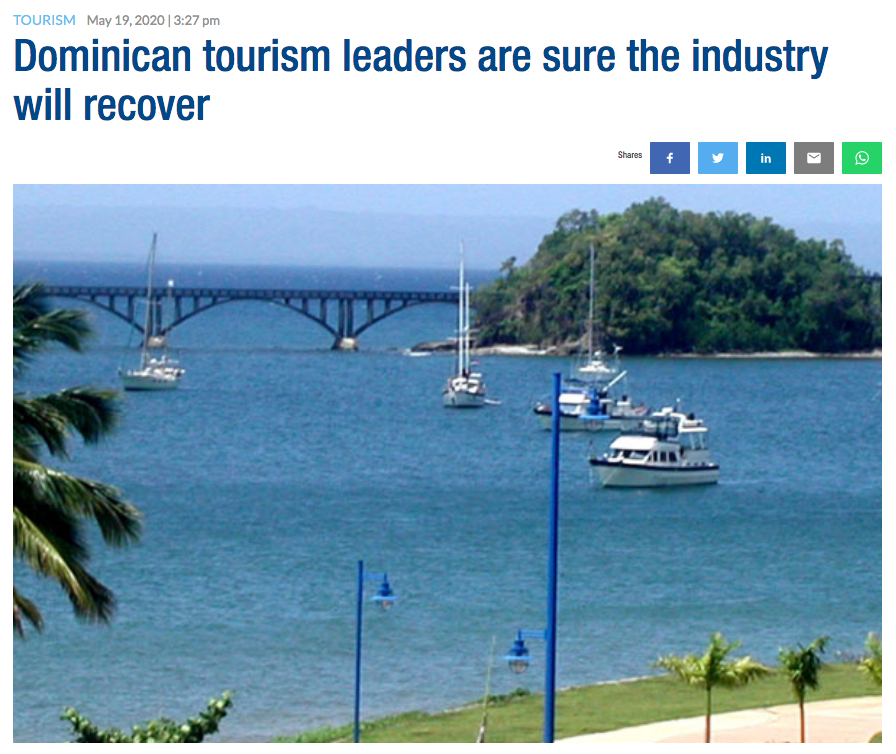
DR Tourism leaders are sure the industry will recover.

Screen Shot 2020-05-19 at 5.25.05 PM.png

Santo Domingo.-  Dominican tourism leaders are sure that the industry will recover the position it has always had, but warns that this will take time, though normalization could begin to occur from the first months of 2021, some say.

“For this it is important to start moving the business. We are making a proposal to relaunch tourism and the idea is to create the conditions to guarantee the health of both our clients and our collaborators, so that we generate confidence in the markets,” says Rafael Blanco Tejera, first vice president of the National Hotels and Tourism Association (Asonahores).

He said both in customers who want to come, as well as in the governments of our issuing markets, will allow their citizens to visit our country.

The also president of the Samaná Tourism Cluster spoke in the virtual conversation “Current situation and challenges of Dominican tourism,” organized by the Dominican Tourism Press Association (Adompretur).

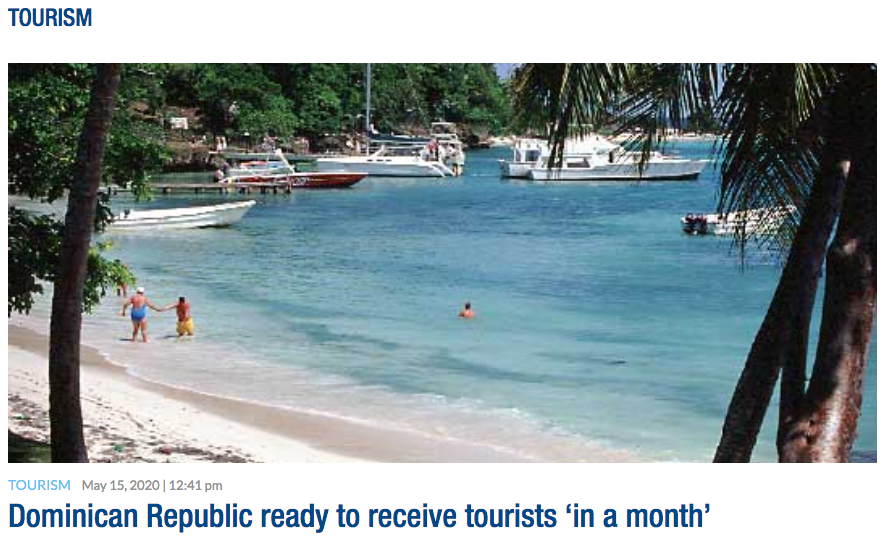
DR ready to receive tourists “in one month”

Screen Shot 2020-05-18 at 4.04.31 PM.png

Santo Domingo.-  Tourism Minister, Francisco Javier García, on Fri. said tourists will go to those places which had best managed the coronavirus. He affirmed that the Dominican Republic will be ready to receive tourists in one month. When asked when will the Dominican Republic be ready to start receiving tourists?, Garcia said, "In a month, because the protocols will be ready in a month."

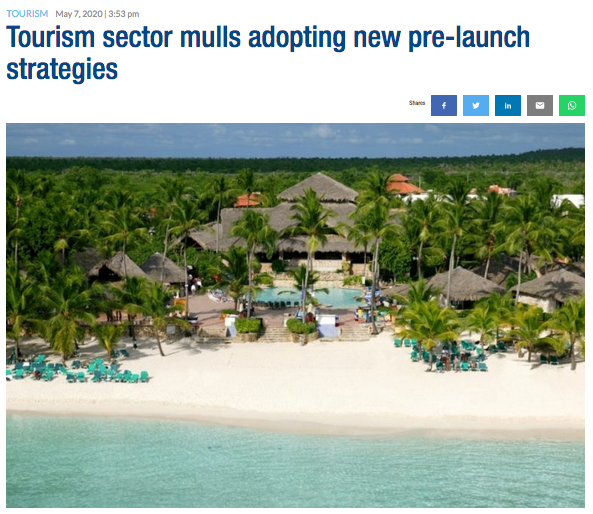
DR Tourism sector reviews pre-launch strategies.

Screen Shot 2020-05-12 at 3.57.40 PM.png

Santo Domingo.- The national tourism sector analyzes the adoption of new strategies, which include incentives for internal tourism and permanent and continuous connection with the external market, to gradually relaunch it.

The joint statement s from business leaders Joel Santos and Andrés Marranzini, past president and current vice president of the National Association of Hotels and Restaurants (Asonahores), respectively.

Tourism Ministry Marketing Advisor, Magaly Toribio also agreed with the strategy, when she participated in two special editions on Tourism Perspectives, aired on the radio program “The Government of Women.”

IMF loans DR US$650M to fight pandemic

Screen Shot 2020-05-05 at 10.32.25 AM.png

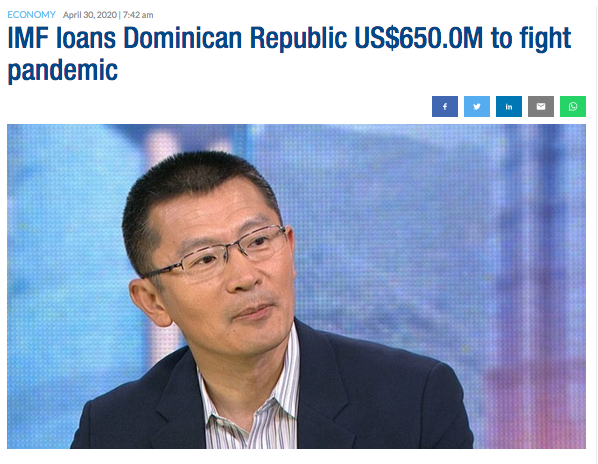
Santo Domingo.- The Executive Board of the International Monetary Fund (IMF) on Wednesday approved a loan US$650.0 million for the Dominican Republic, as part of the emergency funds to face the pandemic.

The IMF noted that “the pandemic has significantly weakened” the country’s macroeconomic prospects for 2020 and created financing needs that require additional support.

The emergency financial assistance was established under the Rapid Financing Instrument (RFI). It said the authorities are also seeking the assistance of other multilateral institutions.

“The severity of the COVID-19 global ‘shock’ has disrupted the economy of the Dominican Republic and created urgent needs for balance of payments and fiscal financing,” said IMF Deputy Managing Director Tao Zhang.

Major US airlines to resume flights to DR In June.

Screen Shot 2020-05-05 at 10.25.49 AM.png

JETBLUE, AMERICAN, DELTA, and UNITED

The United States airlines that lead the flow of passengers between that North American nation and the Dominican Republic, such as JetBlue, American, Delta, and United, estimate to resume their flights to the Dominican market as soon as the end of May and the beginning of June.

JetBlue, according to its flight search engine, estimates the restart of its operations on the New York-Santo Domingo route by May 29. On its New York-Santiago connection, its main destination in 2019, the company is planning the first flight on June 8.

In the case of American Airlines, it will be on June 2 when the company resumes its New York-Santo Domingo route. For the same day, it plans to start its New York-Santiago frequency, according to the company’s website.

Delta Air Lines is scheduled to restart operations on Tuesday, June 2, on its connection from New York to Santo Domingo and the same date for its route from the “Big Apple” airport to the Cibao terminal, according to Diario Libre.

Meanwhile, United estimates the return to service of its New York-Santo Domingo route for May 30, while by June 4 it would be starting to connect the US city with the Santiago airport.

Of the 14,429,906 passengers that entered and left the country in 2019, these four airlines were responsible for transporting 6,610,568 travelers between the United States and the Dominican Republic, according to JAC figures.

It is recalled that on March 19, President Danilo Medina ordered by decree the closure of air borders, as a mechanism to prevent the spread of COVID-19.

DR selected as BEST destination in America’s.

Screen Shot 2020-05-04 at 11.01.06 AM.png

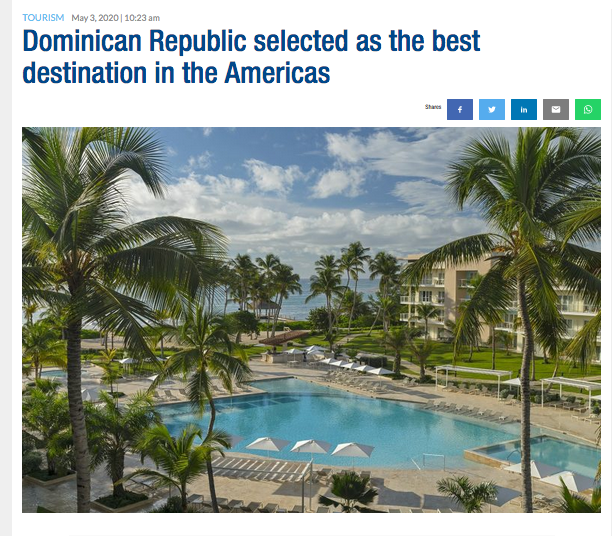
Santo Domingo, May 3.- The Dominican Association of Tourist Press (Adompretur) reported this Saturday that Traveller’s Choice, the annual award for TripAdvisor travel platform, selected the Dominican Republic as the best destination in the Americas and the 13th best in the world.

The entity said that the Travelers’ Choice awards are granted based on millions of opinions and comments from travelers from all over the world and reflect “the best of the best” in terms of service, quality and customer satisfaction, from hotels and accommodations to destinations, attractions, brands, and tourist products.

Adompretur considers that the prestigious award given to Dominican tourism should not only constitute a source of pride and celebration for the entire country, but also a source of inspiration and optimism to overcome the difficult circumstances facing the sector today as a result of the coronavirus pandemic.

The list of the most appreciated tourist destinations is headed by London, from the United Kingdom; Paris France; Crete, Greece; Bali, Indonesia; Rome Italy; Phuket, Thailand; Sicily, Italy; Mallorca, Balearic Islands; Barcelona, ​​Spain; Istanbul, Turkey; Goa, India; Dubai, United Arab Emirates, and the Dominican Republic.

Cuba, in number 19, and New York, in number 25, also appear among the top 25 destinations in the world as part of the American continent. In addition, it is highlighted that Bávaro Beach, in Punta Cana, is ranked 19th among the 25 best beaches in the world.

Selection is made annually based on comments from millions of TripAdvisor members. The Travelers’ Choice Awards not only highlight the most common preferences, but also the exceptional attributes that make travelers repeat a visit to a destination.

The information on the Dominican Republic published on the TripAdvisor portal includes various images of the country’s tourist attractions and highlights that the first destination in the Caribbean is in the same waters that bathe Cuba and Puerto Rico, occupying two-thirds of the eastern part of the island that shares with Haiti.

It also highlights that the Dominican Republic is ideal for the family and has a perfect climate.

IATA study shows recovery will begin with domestic flights

Screen Shot 2020-04-27 at 4.16.09 PM.png

An IATA study indicates that the recovery will begin with domestic flights, but that international routes will take longer to reactivate

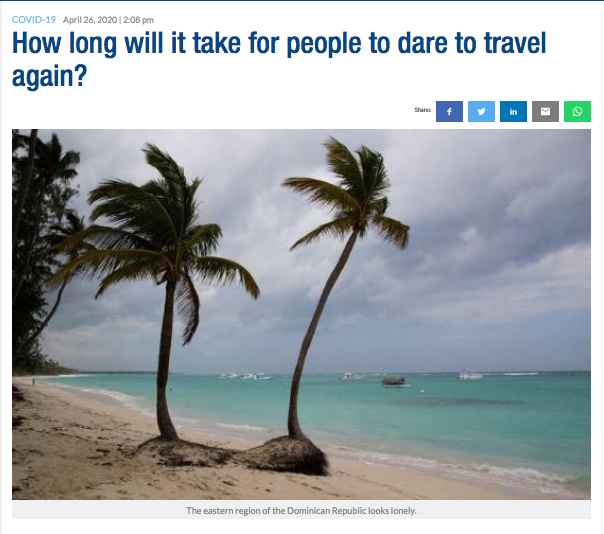
Travelers will give a lot of thought before getting back on a plane when the COVID-19 crisis is overcome. According to a study by the International Air Transport Association (IATA), 40% of passengers will wait six months or more to travel again once the containment of the new coronavirus is announced.

The union of air carriers carried out the survey at the beginning of this month in eleven countries, including the United States, Canada, and Great Britain, where a good part of the tourism that the Dominican Republic receives comes from. 

The study indicates that 28% of the respondents said that they will wait six months or more to travel, while 8% will wait at least one year and 4% answered that they are not even considering getting on a plane in the near future. About 47% said they will wait a month or more to travel, while a small portion of about 14% said they will not wait to get back on a plane. 

Although more than half will wait for a little while before returning to travel, there is another important portion that won’t wait and that is why airlines are projecting a half recovery, if at the end of this year. Everything will depend on the recovery of passenger confidence, which will be crucial to reviving this sector.

IATA is estimating that domestic flights will begin to recover in the third quarter of the year, but that the openings of international flights will be slower. 42% of passengers travel on international routes, while 58% do so in domestic markets, the strongest being the United States and China.

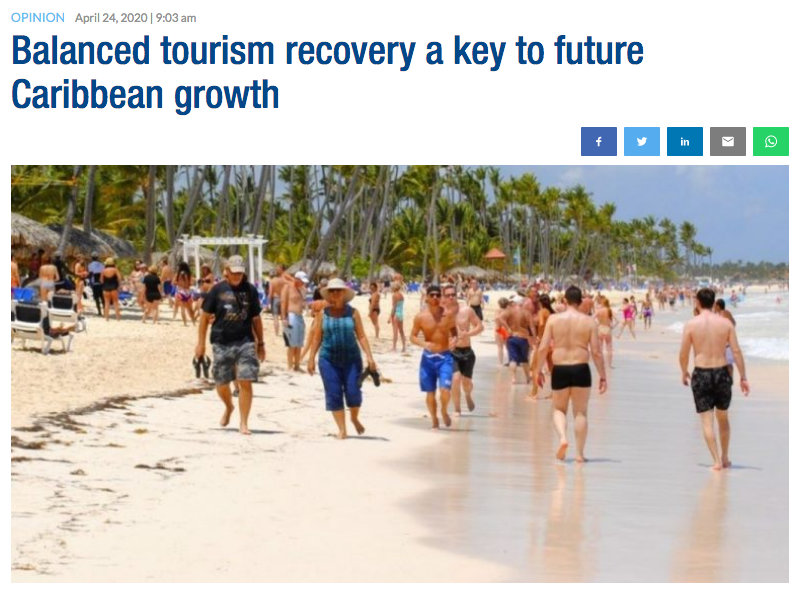
A key to future Caribbean growth

Screen Shot 2020-04-24 at 3.54.12 PM.png

The View from Europe

David Jessop, Dominican Today senior Op-Ed contributor

The challenge that is now facing almost every Caribbean nation is how best to recover the tourism economy without which future economic growth and sustainable tax revenues will be all but impossible.

The COVID-19 pandemic has shuttered the industry, made hundreds of thousands of workers unemployed, pushed many hotels, airlines and cruise companies into financial meltdown, and caused travellers to fear placing themselves at risk in any situation where public health cannot be guaranteed.

According to Frank Comito, the CEO and Director General of the Caribbean Hotel and Tourism Association (CHTA) 87% of Caribbean hotels have suspended operations and are not accepting guests. His initial estimates indicate that from March to mid-April the industry lost US$1.3bn in room cancellations and Caribbean Government’s total tax revenue on visitor spend may have fallen by around US$0.5bn.

For the Caribbean, the most tourism dependent region of the world, the obvious consequence is an urgent need to consider when it can reopen for business, how it positions itself when international travel again becomes possible, and how it should adapt its offering.

Some Caribbean countries, most notably Jamaica, are already well ahead of the curve. It has established a multi-disciplinary task force to determine not just how and when to bring visitors back and to ask difficult questions about its tourism model.

Jamaica’s Minister of Tourism, Edmund Bartlett, says that the new group will be asked to establish a realistic view of the tourism baseline that Jamaica has to recover from; give consideration to multiple alterative versions of the island’s tourism future; establish as far as possible a time line; and develop a strategic posture for the journey back, taking account of national imperatives and scenarios. He also believes there is a need for strategies that create a much closer integration with agriculture and data-led thinking about market development.

It is an approach that recognises that tourism and the way it recovers will not be as before and that much more thought needs to be given to forms of sustainability and better-balanced economies.

Nonetheless, the greatest immediate challenge, absent either a vaccine and/or some form of reliable visitor health certification, is that the virus could asymptomatically be imported into the region from countries that have not done enough, have failed to deliver an efficient response, or are simply in denial.

Without a vaccine, such an eventuality will remain politically and electorally sensitive for several years and have xenophobic implications. It will also impact on the frequency of air and sea lift, foreign relations, public health policy, taxation, food security, insurance provisions, and much else, well before the marketing specialists are able to address consumer perception.

Jim Hepple of Tourism Analytics in Aruba believes that governments will be so concerned about importing the virus that US residents in particular travelling to and from the Caribbean will require government approved health documentation to board flights and pass immigration, and on return to the US may for a period be subject to some sort of quarantine, making questionable the idea of a short or even two week vacation

Although regional tourism has a proven ability to recover from crises, and industry optimists are hoping to see visitors return this coming winter season based on the region’s recovery after 9/11 and the 2017/18 global financial crisis, these inflection points provide little guide to where the world economy and by extension where tourism now is. At best, the world and send markets are about to enter a recession or worse, and as polls show would be travellers have become fearful of leaving their own country: factors that suggest that the time horizon for the start not the end of Caribbean recovery may be as late as the fall or winter of 2021.

As Australia and New Zealand have already indicated, it is also quite possible that governments in the region’s major source markets may not immediately encourage external travel, preferring first to incentivise staycations in order to stimulate domestic economic growth and protect public health.

It may also be the case that not every category of visitor the Caribbean has welcomed in the past will wish to or be able to travel. Older travellers may be reluctant and may no longer be able to obtain medical or travel insurance for nations deemed to be at higher risk. Moreover, hotels and other visitor facilities may be cautious about litigation and insurance should the virus reappear in a manner traceable to one of their properties or facilities.

There is also much to be considered in relation to the cruise lines. The first post-pandemic requirement will be to stimulate employment and tax-generating long-stay land-based tourism, then after that to develop a unified regional response to the cruise company’s divisive approach to destinations.

While acknowledging their value, Frank Comito points out the cruise lines need to be better regional players. The Caribbean he says, “will have to explore whether it has the collective will to address from an equity perspective the role of the cruise sector vis-a-vis land-based tourism in its many forms”.

More generally the outlook for a rapid global economic recovery and the return of international tourism is not promising.

Marla Dukharan, one of the region’s leading economists, expects a recession and almost every Caribbean economy to contract causing Governments to have to become more important as drivers of economic activity, needing to come together to find common regional economic solutions involving support from the IMF and others. She also believes that “tourism activity and the businesses which depend even partly on tourists will not see their levels of revenue recover for years to come”.

Addressing all these and other issues will require much thought, joined up local and regional responses, a high degree of realism about how Caribbean tourism markets will reopen, and most likely fierce global competition as all nations see visitors as a means to rapidly power future economic growth.

Just as importantly, the crisis facing the sector offers an opportunity to governments and international financial institutions to think long and hard about how to rebalance Caribbean economies, so that the region in the longer term is much less reliant on the fortunes of a single sector.

A second column addressing the way ahead for the Caribbean tourism economy will appear next week.

David Jessop is a consultant to the Caribbean Council and can be contacted at

david.jessop@caribbean-council.org

Previous columns can be found at https://www.caribbean-council.org/research-analysis/

The World Bank reveals who will escape a strong regional recession

The World Bank reveals that only the Dominican Republic and Guyana will escape a strong regional recession

Shares

Martín Rama, chief economist of the World Bank for LAC, reveals the region will fall 4.6%.

Santo Domingo, DR

In a pessimistic forecast, the World Bank revealed yesterday that the Latin American and Caribbean region would register a sharp fall of 4.6% this year, except for Guyana, which will grow 51.7%, and the Dominican Republic, which will end with flat growth of zero.

However, the multilateral financial organization projects a rebound for 2021 of 2.6% in the region, when the gross domestic product of the Dominican Republic will grow 2.5% and 4% in 2022. The area will experience a sharp recession due to the impact of Covid-19, except for the DR and Guyana, he added.

He suggested prioritizing informal and assuming clear policies

“It is always better to plan for the worst scenario, not for the best,” said the World Bank’s chief economist for the Latin American and Caribbean (LAC) region, Martín Rama. Rama made the comments during a virtual press conference from Washington, DC, in which he recommended to the countries to have clarity of the sectors that are going to require more significant support in the payments of small companies and the protection of employment.

He argued that although everything will depend on the fiscal space of each country, countries should prioritize assistance to people who live day today. He reported that both the World Bank and the International Monetary Fund (IMF) are adopting efforts to mitigate the impact of the COVID-19 in the region with immediate responses and articulated in various stages. Stages such as making available resources to contain the progress of the pandemic, which, in the case of the World Bank, will be US $ 160,000 million globally, in 15 months, to lowest-income countries and middle-income countries in Latin America and the Caribbean.

While the IMF will guarantee greater liquidity to its members with access to the quota, and that will give an increased available surplus to the countries.

“The governments of Latin America and the Caribbean face the enormous challenge of protecting lives and at the same time limiting economic impacts,” said Martín Rama, chief economist at the World Bank for the Latin American and Caribbean region. “This will require targeted and consistent policies on a scale rarely seen before.”

Growth

The region, according to a new World Bank report, experiences a sudden drop in growth due to the Covid-19 crisis, which will require multiple responses in public policies to support the most vulnerable, and avoid a financial crisis.

IMG_2977.jpeg

CoronaVirus update

IMG_2949.jpeg

As you all know by now the global pandemic has touched almost every country. The Dominicana Republic has followed the guidelines of the United States with policy and directives designed to curb the rate of infection spread. A number of weeks ago they shut down cruise ship arrivals and more recently last week have closed all non essential businesses and banned arrivals from all airports from Non Citizens or expats with residence in country.

As such, our company office in NYC has shut down and we are all remote working for the near term. We are still active and working to keep the development on track.

The entire tourism sector on the island is currently on pause. We are keeping close watch on the activities in the DR and will advise the group as we have more updates.

be safe and stay healthy.

New York Times article

Sorry for the bad link. See the article below.

Adjustments.jpeg

By Jon Hurdle - The New York Times

  • March 17, 2020

SOSUA, Dominican Republic — Keith Dobson wanted to buy a retirement home in a sunny place where he could live inexpensively and watch his investment grow while persuading his children and grandchildren to visit once in a while.

With retirement approaching, Mr. Dobson, a store manager with Home Depot near Toronto, looked first in Florida, Jamaica and Barbados but wasn’t comfortable with property prices in those locations. So he was pleasantly surprised when he began looking at the relatively undeveloped north coast of the Dominican Republic.

There, he could buy a new two-bedroom house with a pool in a gated community for $120,000 — a fraction of the cost for an equivalent property in North America — in a country where he could draw his Canadian pension, take out inexpensive private health insurance, and walk to the beach in five minutes.

“We ran into someone who’s a real estate agent near our place in Canada who had invested in properties in the Dominican,” said Mr. Dobson, 62, who plans to retire in April. “He said to us that Dominican is a growing place and there are lots of people moving in, lots of construction going on, and a great opportunity to get in at preconstruction prices.”

So Mr. Dobson and his partner, Mary Cserep, 58, decided to pay $40,000 for a lot at Sosua Ocean Village, a rapidly growing coastal development here, and another $80,000 in four installments for the house, which has two bedrooms and two and a half bathrooms over about 990 square feet, or 92 square meters.

Even better, Mr. Dobson said in an interview at his new property last year that he expected to be able to flip the house for about $80,000 more than the preconstruction price he paid. With the profit and his savings, he then plans to build a 1,500-square-foot house for about $95,000 on an adjoining lot that he has already purchased for $40,000.

When their retirement begins, the couple, who are keeping their home in Ontario, hope to spend about four months a year in the Dominican Republic, where they look forward to becoming part of a growing expatriate community.

“We feel we got very good value for money in a good location,” Mr. Dobson said.

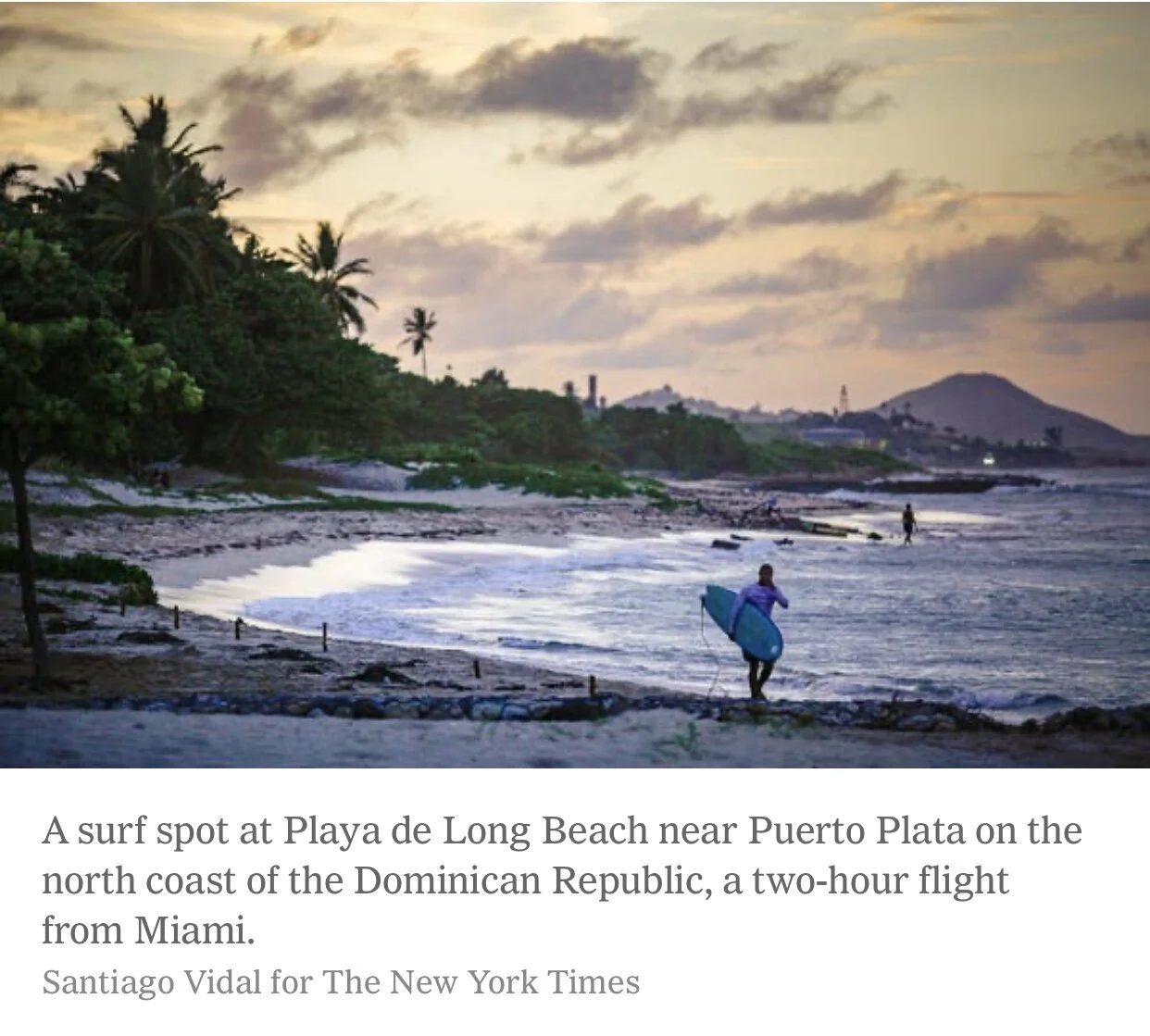
In the nearby town of Sosua, real estate agents recognize that buyers like Mr. Dobson and Ms. Cserep are attracted by the Dominican Republic’s low property prices, low premiums for private health insurance (as little as $32 a month), and good air links with North American cities like Miami, which is less than a two-hour flight from the north coast city of Puerto Plata.

Saskia Conti, who runs Conti & Co., a real estate agency in the area, with her husband, Jonmar, estimated that their revenue has risen about 30 percent in the last year, largely because of increased sales to North Americans, about 70 percent of whom are retirees.

In another sign of a hotter market, many buyers have raised their target price to the $100,000 to $250,000 range, from the $50,000 to $100,000 that was previously typical, she said.

But she predicted that future price gains will be modest because of an increasing supply of newly built properties and a surplus of older homes that are harder to sell because most buyers want new construction to their own specifications, and can get it for about the same cost as an existing home.

Ms. Conti attributed her stronger sales to an improvement in the North American economy, prices that are significantly lower than in the United States, Canada or Europe, and the absence of property taxes on the first $150,000 of a purchase price.

Dominican Republic municipal elections- update

IMG_2931.jpeg

Municipal elections: The good news is that there is no news
For the most part, reports are that the Extraordinary Municipal Election was practically eventless. As of 5 pm on Sunday, 15 March 2020, expectations that there would be a large turnout of voters was not happening, Alicia Ortega for Noticias SIN reported. 

Abstention of around 50% is considered normal, despite expectations of a larger than usual turnout of young people. By the early afternoon, only a trickle of voters kept the polling stations officers busy at most centers. Abstention is expected to be more than 65-70% this time around. 

This year, voters for the first time were casting votes for the city councilors of their choice. In the past, the city councilor was decided depending on the number of votes cast for a city mayor. The city councilors were listed in the order decided by the political party. 

The municipal election is happening on the heels of the country being in the containment phase of the Covid-19 virus. But the representative of the Pan American Health Organization, Alma Morales, called on Dominicans to go out and vote, leaving the polling places to avoid conglomerations afterwards. Gel with alcohol was available for voters to wash up before and after the vote. 

Reports are that most people had voted by 3 pm, though, with a trickle of voters after that hour. The polls closed as scheduled at 5 pm. 

The president of the Central Electoral Board (JCE), Julio Castaños Espaillat, announced that the 16,032 polling stations had operated successfully nationwide. "We announce that from an organizational point of view, the election was a success," he said. "The JCE has complied with its mission and the event has been reinstated. Democracy has been salvaged. The Dominican people have elected their municipal authorities," he told Dominicans at the close of the polls at 5 pm. 

He summed up: "Reports are that all is normal. There has not been an incident that could affect the results. All has gone in order and peacefully. The Dominican people have chosen."